Keeping a shelter supplied after a tornado
A shelter can get a request for drinking water through and still run out before a truck arrives. I studied how road access, communications, and backup power affect that gap.
How I modeled the response
I used a historical tornado as the starting point for a scenario on present-day roads. The study map shows where I assumed the storm caused damage and where I assumed access was interrupted. I used a discrete-event simulation to track when a water request reached an operator, when it was acknowledged, and when the truck could actually deliver the water.
I varied how long roads were closed and when people needed water. Then I compared ways for shelter operators to stay in touch on backup power, including voice radio, short text messages, and an internet connection. Each faced the same road closures, arrivals, starting supplies, and messages.
What the scenarios showed
Water already at the shelter bought time. Even with an early request, the truck could only unload after the road reopened. I ran the same closure twice to see whether extra water at the shelter would cover demand until then.
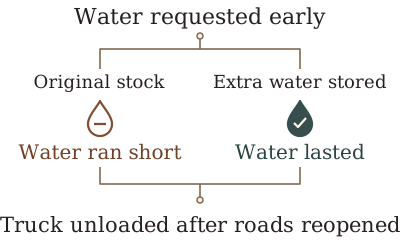
In a separate check, I spread demand more evenly through the day and varied when the road reopened. The same stock lasted through a shorter closure and ran out during a longer one.
Keeping a connection open had a power cost. I compared the battery capacity needed to keep four communications setups running for the same period. Voice radio alone needed the least. The short-text setup needed less battery capacity than either internet setup and still let an operator send a water request and receive an acknowledgment.
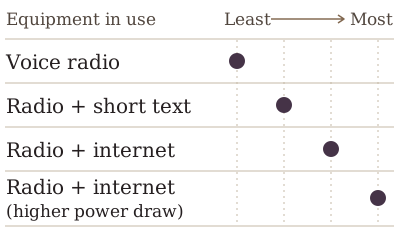
With the radio and the lower-draw internet terminal running continuously, the smaller battery ran out before the simulation ended. For the higher-draw terminal, I calculated the energy needed over the same period. That setup also needed more energy than the smaller battery could supply.
What a community would need to measure
These are results from modeled scenarios. To apply them to a particular shelter, I’d need to know how much drinking water it keeps, when demand peaks, and which roads a delivery truck can use. I’d also want to measure what the communications equipment draws on backup power and test whether operators can exchange and acknowledge messages from the places they’ll actually be working.
Study by Vincenz Dickerson · All independent research