Methods
How I approach an analysis
Suppose one design is cheaper and another is faster to deliver. Which designs are worth considering, and what would you gain by spending more?
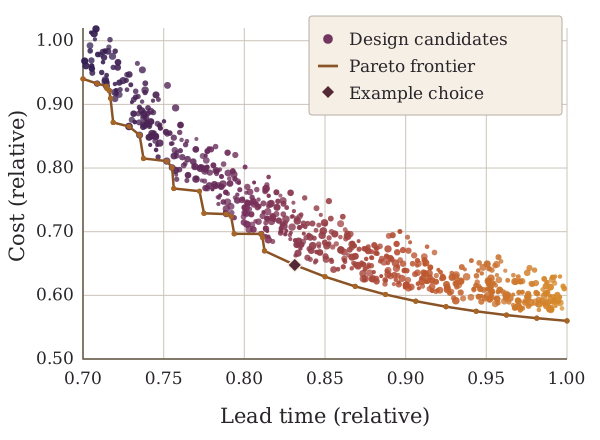
Comparing cost and lead time
Each point is a design. Cost and lead time are shown relative to reference values of 1.00. A relative cost of 0.80 means a design costs 80% as much as the reference.
If another design costs less and delivers at least as soon, or delivers sooner for the same cost, you can rule out the first design on these two measures. The line connects the remaining choices, called the Pareto frontier. The diamond marks one possible choice.
A firm deadline rules out any design that arrives too late. If the date is flexible, use the reference cost and lead time to turn the differences into dollars and days. How much is each day saved worth to you?
Choosing a technique
Design of experiments
When several inputs may matter, I plan model runs that vary them in combination. That lets me estimate the effect of changing one input and see whether its effect depends on another.
Quantifying uncertainty with Monte Carlo sampling
When the inputs are uncertain, I specify plausible distributions and account for relationships between inputs. Repeated draws show the spread of outcomes under those assumptions.
Sensitivity and scenario analysis
I test whether a different assumption changes which option I would recommend. If a staffing choice turns on how late orders arrive, for example, arrival records are the first evidence I’d look for.
Optimization
I define what counts as a feasible choice and what the analysis should improve. Then I compare promising options and check how they perform if the operating conditions change.
Illustrative method examples
- Worked example with synthetic dataWhen does a second packing station help?
- Worked example with synthetic dataWhat should a pilot measure before expansion?
- Illustrative study designThermal system performance study
- Illustrative study designManufacturing process optimization
- Illustrative study designSupply chain resilience analysis
- Synthetic model illustrationEquipment reliability and replacement